Myeongwoljinseong (명월진성) in Hallim, Jeju — The Largest of the Island's Nine Garrison Fortresses
Myeongwoljinseong, the largest of Jeju's nine garrison fortresses, was built in 1510 and rebuilt in stone in 1592 to defend the island's northwest coast. Walk the restored south gate and barbican, and trace the hidden remnants of a fortress that once anchored Jeju's coastal defense.

As we know, Jeju is an island surrounded by the sea on all sides. That also means it has always been exposed to external threats from every direction. Defensive structures were built across the island for this very reason.
Jeju's Defense Heritage: Three Walled Towns and Nine Garrison Fortresses
Over a span of 250 years starting from the 1300s, Japanese pirates (waegu, 왜구) invaded Jeju more than 30 times. To counter these threats, a defense system known as the "Three Walled Towns and Nine Garrison Fortresses" (3성 9진, samseong gujin) was established. The Three Walled Towns refer to the county seats of Jejumok (제주목), Jeongui-hyeon (정의현), and Daejeong-hyeon (대정현). And ringing the entire coastline of the island, nine garrison fortresses stood watch: Hwabukjin (화북진), Jocheonjin (조천진), Byeolbangjin (별방진), Susanjin (수산진), Seogwijin (서귀진), Moseuljin (모슬진), Chagwijin (차귀진), Myeongwoljin (명월진), and Aewoljin (애월진).
Historically, Myeongwolpo (명월포) — the harbor at Myeongwol — was a strategic landing point. In 1270, Lee Mun-gyeong (이문경) of the Sambyeolcho (삼별초) landed on this shore, drove out the government forces sent by the Goryeo court, and seized control of Tamna. In 1374, General Choi Yeong (최영), who came to suppress the revolt of Mongol ranch overseers (mokheo, 목호), also chose this very spot to come ashore. Myeongwolpo was that important, militarily speaking. Myeongwoljinseong was the northwestern anchor of Jeju's coastal defense network, a fortress perched on the shore of Myeongwol-ri in Hallim-eup, Jeju-si.
How Myeongwoljinseong Was Built
Myeongwoljinseong began in 1510 (the 5th year of King Jungjong's reign), when Jeju Moksa (governor) Jang Rim built a small wooden palisade fort at Myeongwolpo in response to Japanese pirate ships appearing near Biyangdo (비양도). It was a hasty measure — a wooden stockade thrown up under urgent threat. Then, about 80 years later in 1592 (the 25th year of King Seonjo's reign), Jeju Moksa Yi Gyeong-rok reinforced the defenses by replacing the wooden walls with a proper stone fortress, right around the time the Imjin War (Japanese invasion of Korea) broke out.
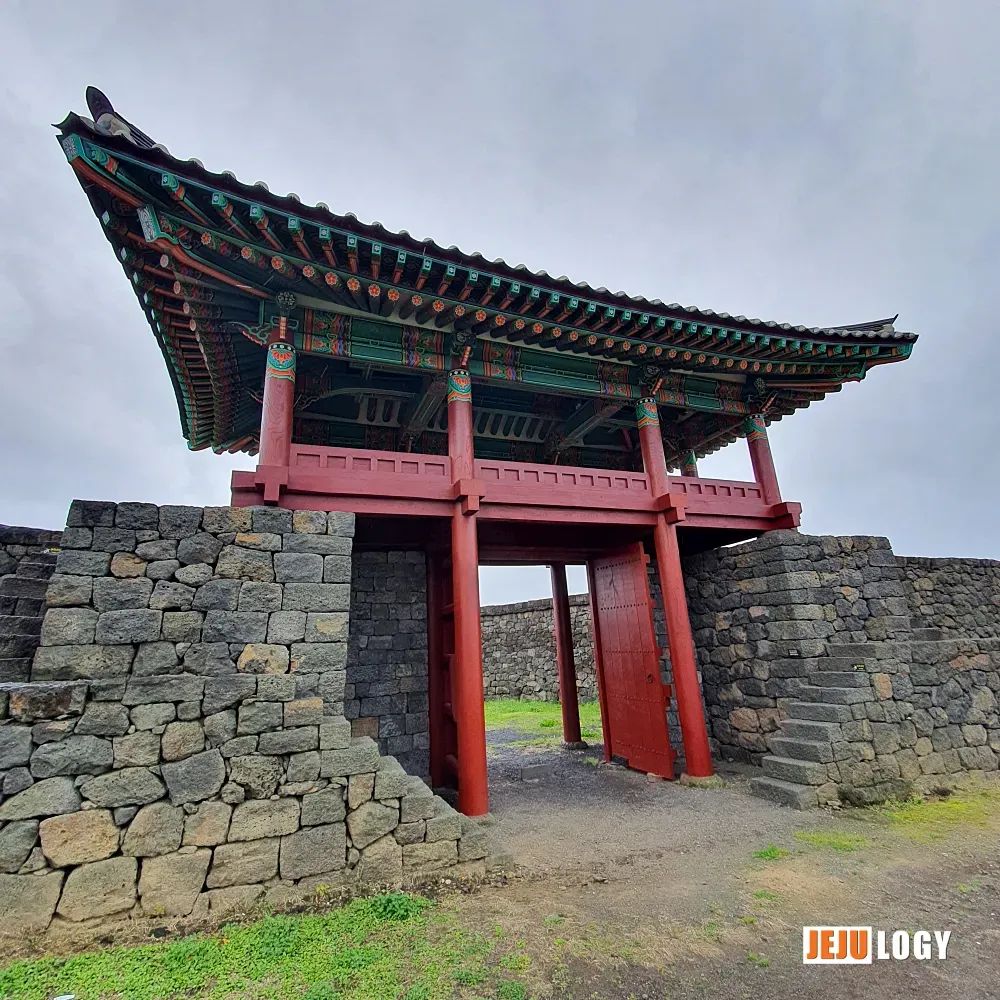
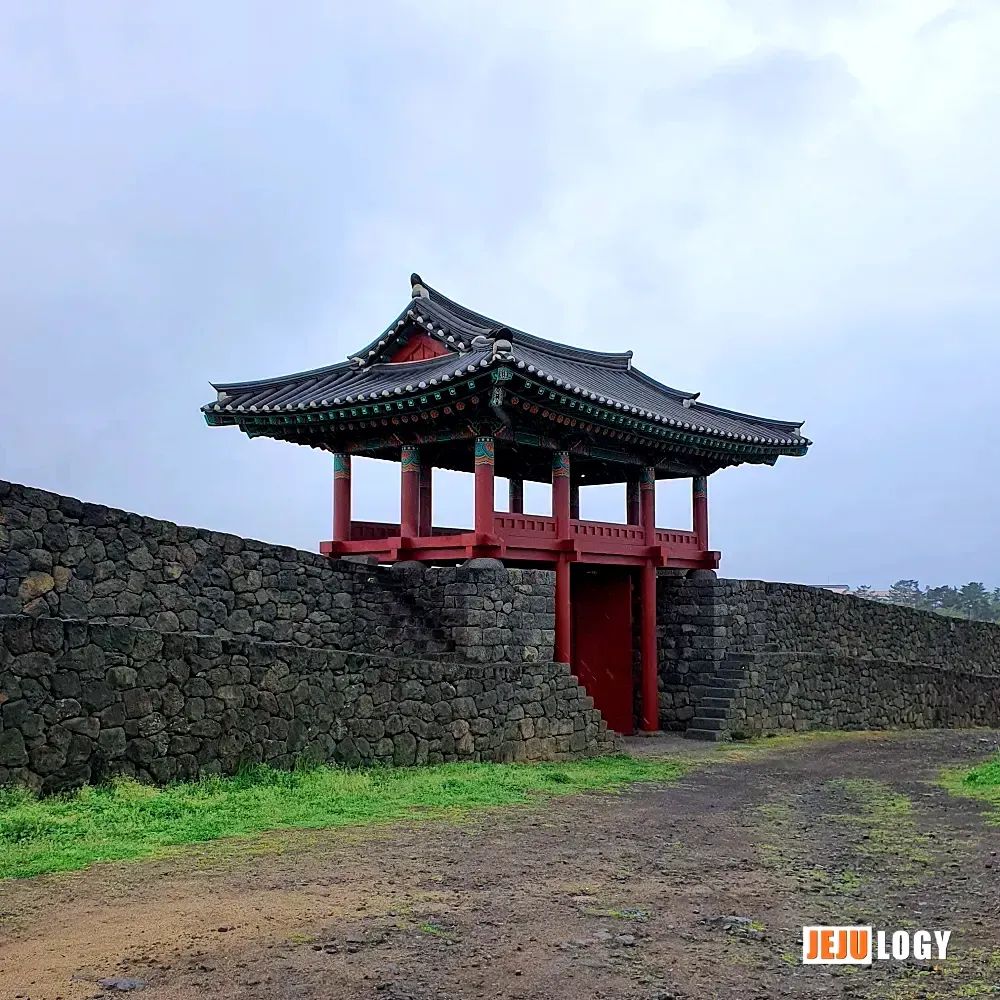
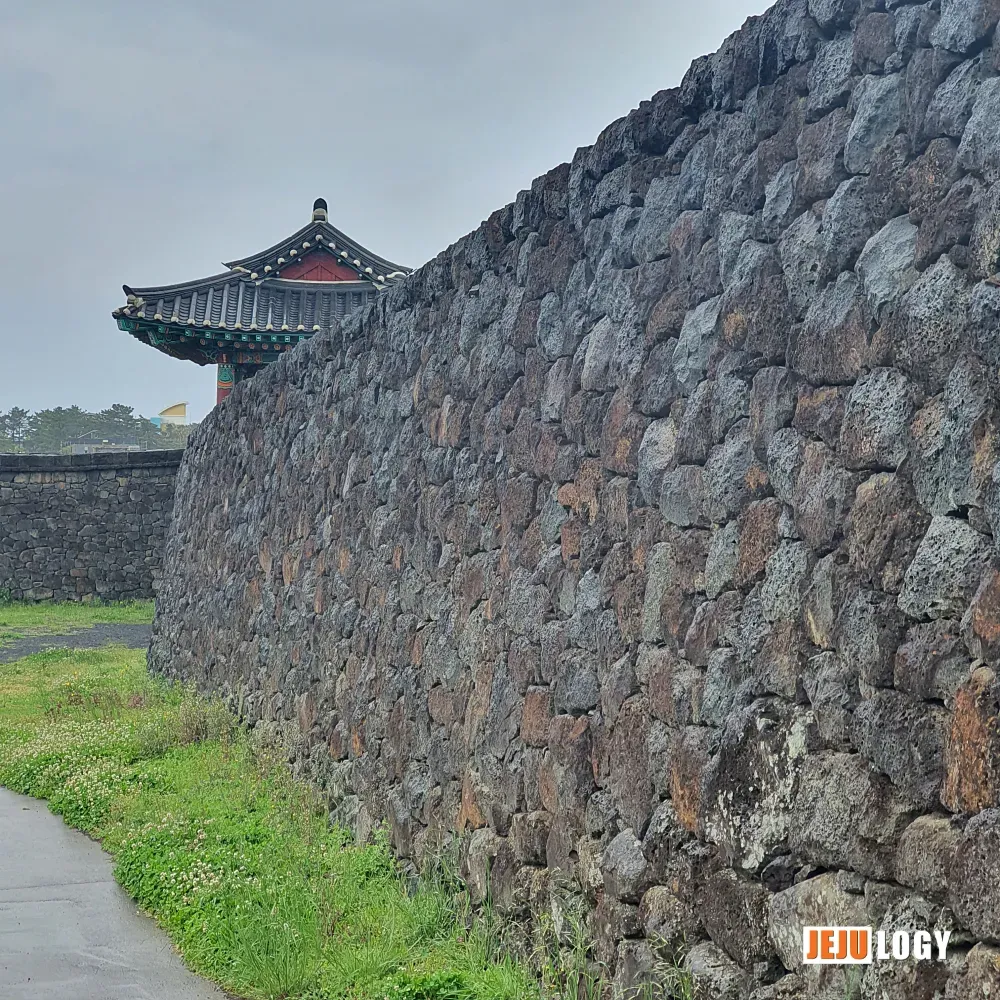
Three gates and watchtowers (choru, 초루) were added at this time, expanding the scale and completing a solid, formidable stronghold. The gates were built in the pyeonggeo style — a flat-top design, as shown in the photo above.
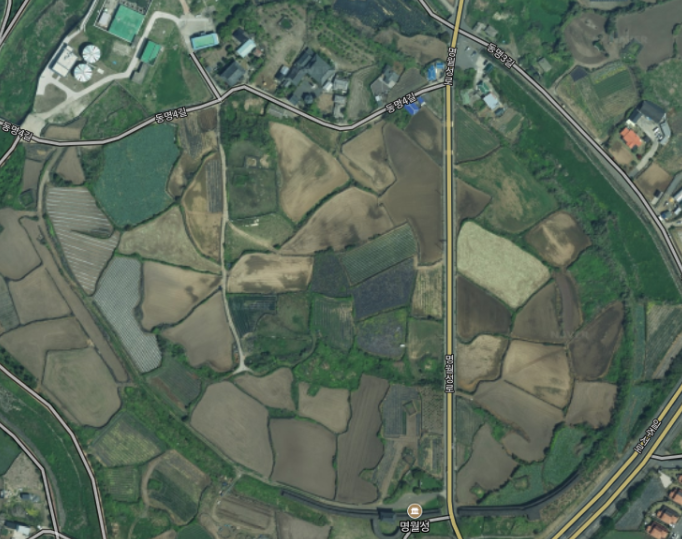
Seen from above, Myeongwoljinseong has a roughly oval footprint, slightly elongated along a northwest-to-southeast axis. Even on foot, if you follow the curving line of old wall stones running between village houses and fields, you can trace out the general circumference. The perimeter measures roughly 1.3 to 1.5 km, with walls standing about 4 meters high.
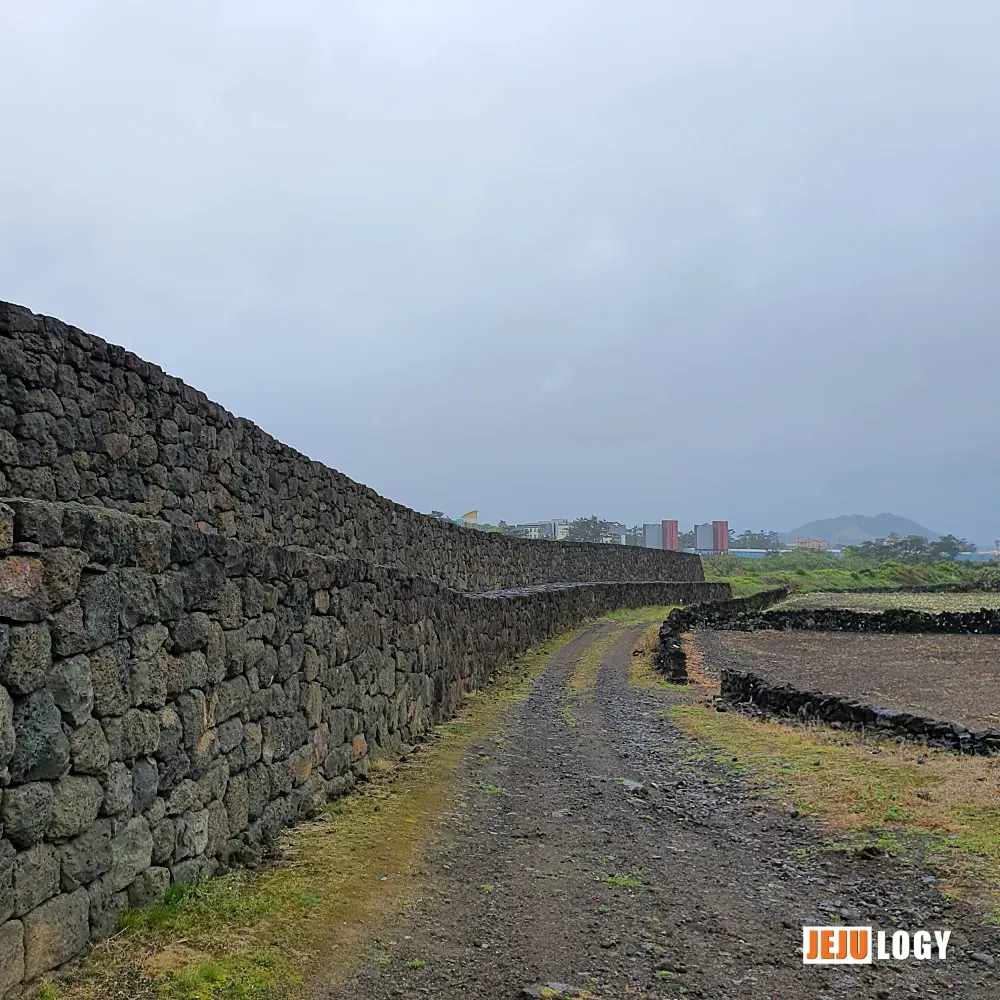
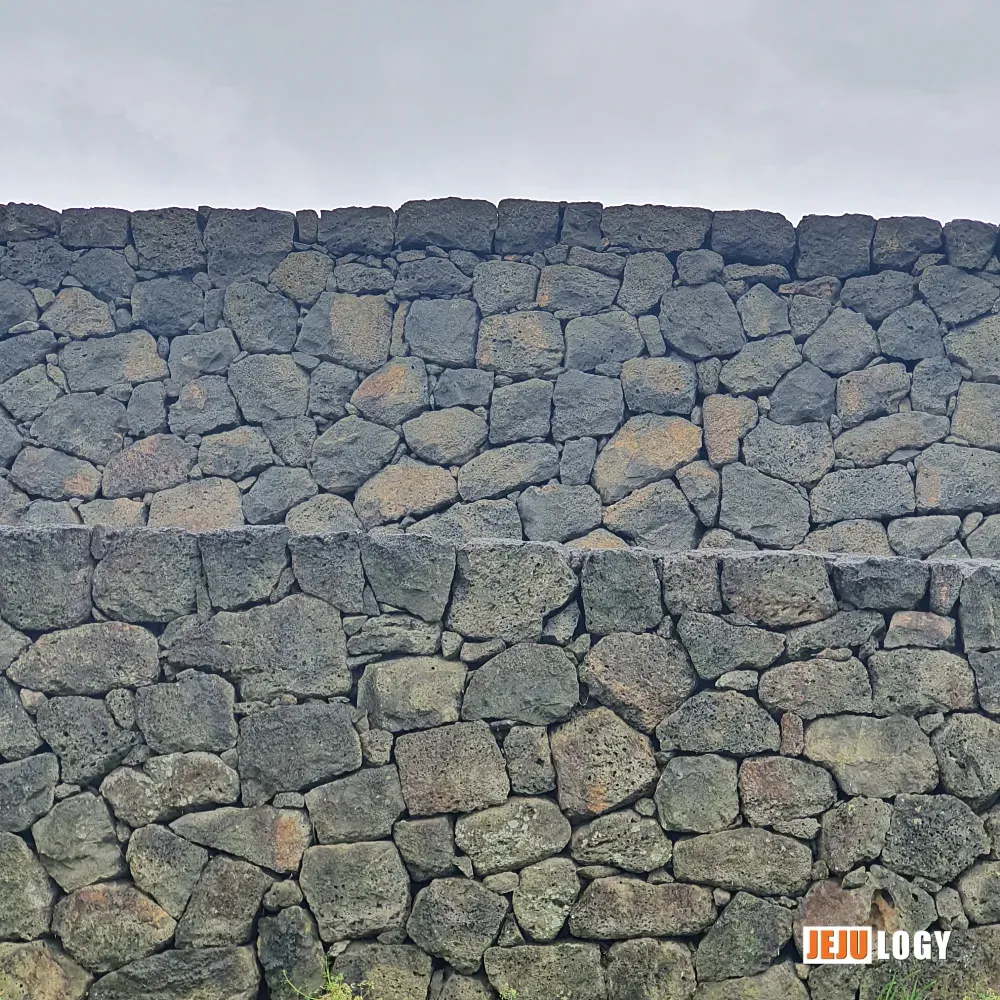
The walls were originally constructed by carefully stacking natural basalt blocks with their flat, squared faces pointing outward. The wall thickness exceeded 2 meters — a very sturdy build.
Gates were installed on three sides — east, south, and west. Each gate was fitted with a semicircular ongseong (옹성, a protruding barbican wall designed to shield the gate from direct attack).
At vulnerable corners and along weak stretches of the wall, chiseong (치성, protruding bastions for flanking fire against approaching enemies) were placed. Between the south gate and east gate alone, three such bastions were positioned. As for a moat — Jeju's volcanic soil doesn't hold water well, so instead of a water-filled ditch, they reportedly planted rows of thorny trifoliate orange trees (tangja, 탱자나무) as a living barrier.
The primary building material was black basalt, readily available on site. While sections of the wall have been damaged over the centuries, the lower portions of the original wall survive along substantial stretches, with later restoration work continuing above them.
The Largest of the Nine: A "Grand Fortress"
The importance of Myeongwoljin only grew over time. In 1764 (the 40th year of King Yeongjo's reign), Royal Inspector Yi Su-bong petitioned the court to upgrade the rank of the fortress commander (jinjang, 진장) from jogbangjang (조방장, a junior 5th rank officer) to manho (만호, a senior 4th rank position). The court also mandated that the appointee be a Jeju-born military officer. This upgrade alone tells you how seriously the court regarded Myeongwoljin within Jeju's defense system.
Myeongwoljin was a hybrid — part military garrison, part civilian settlement. Soldiers and residents lived side by side within its walls. The surviving fortress perimeter stretches roughly 1.4 km, making it the largest of Jeju's nine garrison fortresses. Kim Sang-heon's Namsarok (남사록, "Record of a Southern Journey") records the circumference as 3,050 cheok and the height as 9 cheok. Converted to modern measurements, that comes to about 952 meters in circumference and 2.8 meters in height. In person, it felt longer and taller than those numbers suggest. The old records don't quite match modern surveys, but the key point stands: this was, by any measure, the largest of all the garrison fortresses.
During the late Joseon period, the manho (naval commander) at Myeongwoljin oversaw 2 beacon stations (bongsu, 봉수) and 7 signal platforms (yeondae, 연대) — again, the most extensive command of any of the nine fortresses.
In the late 18th century, during King Jeongjo's reign, Royal Inspector Bak Cheon-hyeong inspected Jeju and filed a report describing Myeongwoljin as follows: situated between Jeju and Daejeong, with fertile land and abundant seafood, the finest among the nine fortresses; the interior of the fortress was spacious, the people prosperous, and with springs and granaries in place, it was self-sufficient — a true "geojin" (거진, Grand Fortress).
Myeongwoljin was not merely a walled stronghold on land. It doubled as a naval base for coastal defense. A naval outpost called sujeonso (수전소) was established along the shore, reportedly garrisoned with panokseon warships (판옥선, the standard Joseon-era warship) and some 100 oarsmen. In this way, Myeongwoljinseong served as a critical military hub defending both land and sea, protecting Jeju's northwestern coast against Japanese pirate incursions.
'Myeongwol Sisa' from the Tamna Sunryeokdo
The Tamna Sunryeokdo (탐라순력도) is a pictorial album documenting the military and administrative inspections of Jeju, produced during the tenure of Jeju Moksa Yi Hyeong-sang in 1702. Below is the painting titled "Myeongwol Sisa" (명월시사, "Archery Inspection at Myeongwol") from that album.
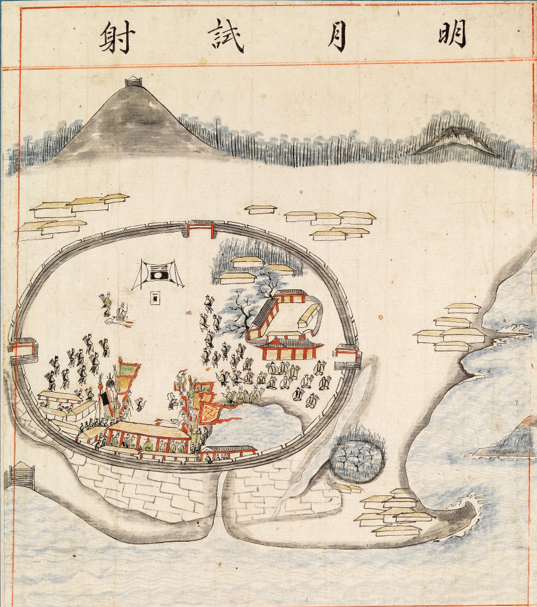
It depicts an archery scene at Myeongwoljin. An interesting detail in the inscription: on the 14th day of the 11th month in the year Imo (1702), the 17 archery instructors (gyosajang, 교사장) on the right side of the field lost by 141 points.
Myeongwoljin had a guesthouse (gaeksa, 객사), armory, granary, and archery ranges — reportedly four of them. The garrison numbered around 400 soldiers, with an additional 180 horse herders (mokja, 목자) and their assistants (boin, 보인), who were essential for maintaining the military's mobility. With so many people gathered in one place, fresh water was critical. A year-round stream called Gamcheon (감천, "Sweet Spring") ran through the area — this is today's Myeongwolcheon (명월천).
Inside the fortress walls, ample space was set aside for stockpiling supplies and quartering troops in case of emergency. A spring in the center of the fortress provided a steady supply of drinking water. Buildings including the armory, guesthouse, and auxiliary granary (byeolchang, 별창) supported both administrative and military operations. Four archery ranges inside the walls ensured that troops trained regularly. All these buildings are gone today, but you can still infer the old layout from the spring site and the flat open ground that remains.
The Yang Je-hae Prison Case
In 1813 (the 13th year of King Sunjo's reign), the Yang Je-hae Prison Case (양제해 옥사사건) unfolded. Here is what happened. A group of low-ranking officials formed a clique called sangchangye (상찬계) and used it to exploit and extort the local people. Yang Je-hae, representing the aggrieved villagers, compiled a written account of the officials' abuses and prepared to submit it to higher authorities. But one of his sympathizers, a man named Yun Gwang-jong (윤광종), betrayed him and reported the plan to the very officials being targeted. Yang Je-hae was framed on charges of sedition, tortured, and died in custody. Yun Gwang-jong, the informer, was rewarded with the post of Myeongwol Manho — the 4th-rank military commander and chief administrator of Myeongwoljinseong. I include this episode because it is a story directly tied to this fortress.
Myeongwoljinseong Today — And What Remains
The site of Myeongwoljinseong was designated Jeju Special Self-Governing Province Monument No. 29 on September 9, 1976. Since then, Jeju City and the Jeju World Heritage Center have carried out multiple rounds of preservation and restoration work.
As mentioned above, a 2001 excavation of the south gate area uncovered the foundation stones of the gate tower (munru, 門樓) and part of the ongseong barbican. The following year, during restoration work in 2002, a farmhouse that had been built over the ongseong site in front of the south gate was demolished, and the original base stones of the barbican were excavated intact.
For context: an ongseong is a semicircular or U-shaped auxiliary wall built outside a gate to prevent the gate from being directly exposed to the enemy. Think of it as a protective shield wall for the gate entrance.
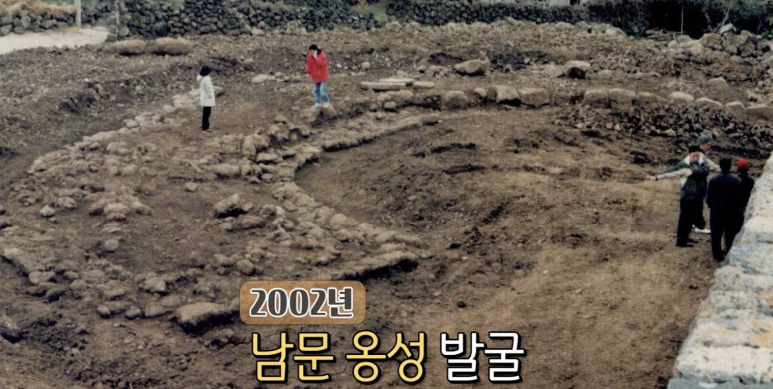
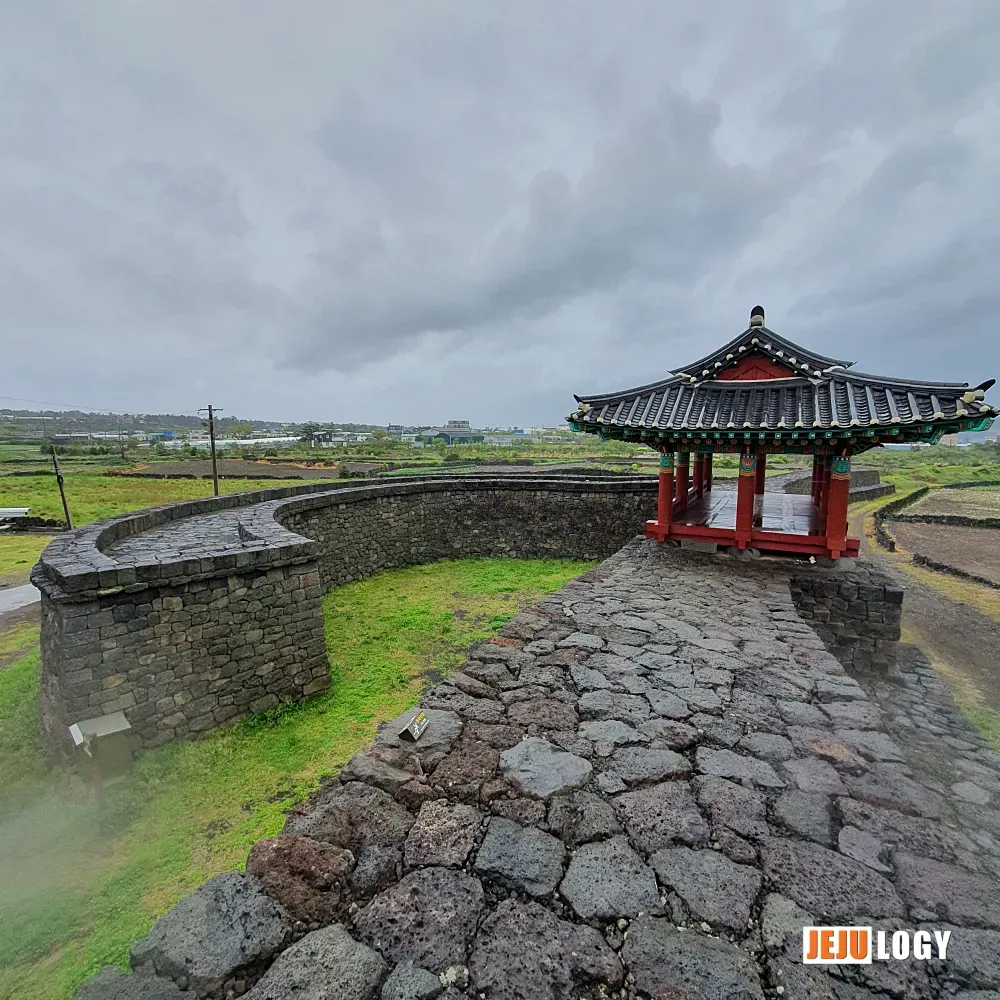
Based on these findings, the south gate, its ongseong, and the gate tower have been restored to something close to their original form. The currently restored wall stretches about 250 meters centered on the south gate, and the barbican and gate structures have been properly maintained. The remaining sections of wall along other stretches survive mostly in their original condition — some as low foundation stones, others as partially standing walls. Near the east gate site, a portion of the barbican's curved outer wall still exists. However, the east gate barbican area is now occupied by private homes, making it difficult for visitors to clearly observe the structure.
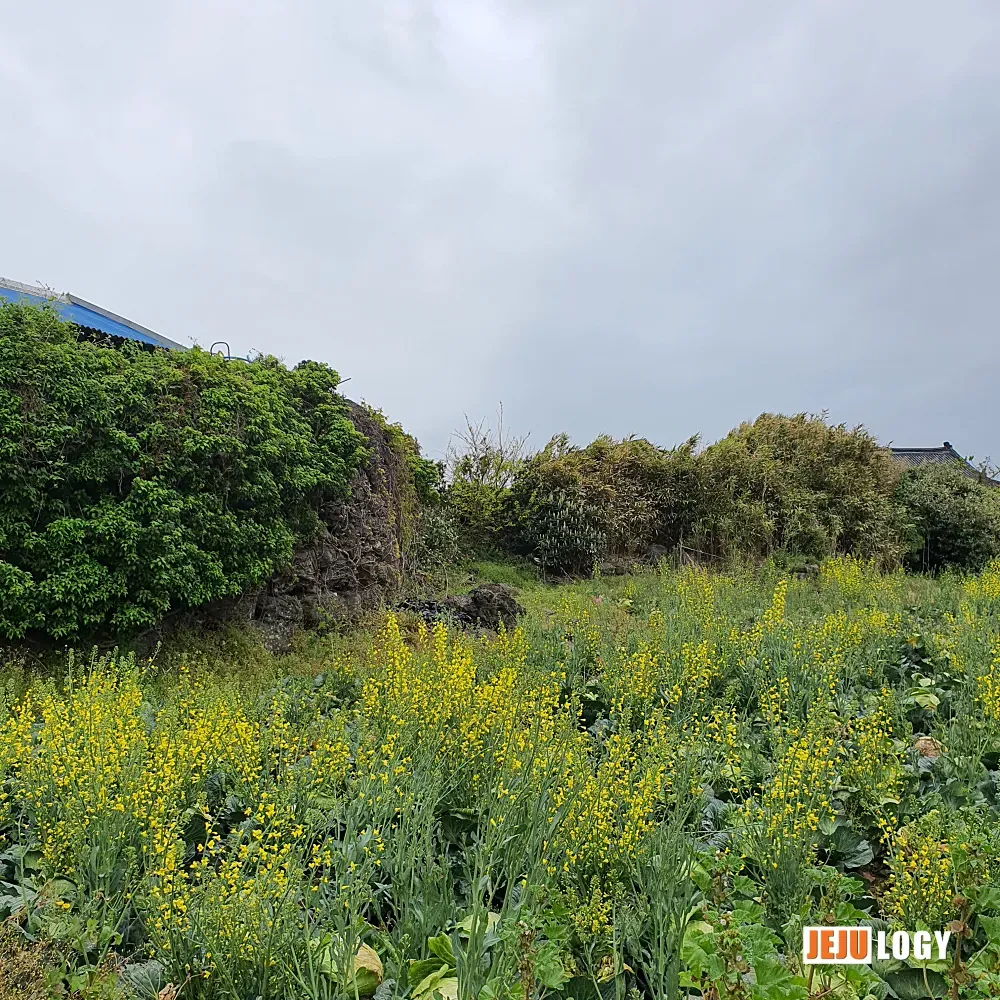
Whether fortunate or unfortunate, beyond the handsomely restored sections, there are places where traces of the original eastern wall actually survive in situ.
I visited one such spot after seeing it featured on GoGo Jejuchajgi (고고 제주찾기, a local heritage program). Without having watched the show, you would never notice it. These kinds of hidden remnants are not uncommon in Jeju. Parts of Jeju Fortress walls, sections of Aewoljinseong, Susanjinseong — they were all like this.
I once wrote, when talking about Jeju Fortress (제주성), about my anger over the Japanese colonial government demolishing the fortress walls to use as landfill material for Jeju Harbor in the early 20th century. Myeongwoljinseong suffered a similar fate. In the 1910s, the Japanese colonial fortress demolition order led to the removal of the gates and the beginning of stone loss.
But the reality did not improve even after Korea gained independence. The most significant destruction of Myeongwoljinseong happened in the 1960s — under the Republic of Korea. Just like Jeju Fortress, Myeongwoljinseong was dismantled and its stones used as landfill for the construction of Hallim Harbor. It was destroyed for development barely 60 years ago. It was a time when awareness of cultural heritage was painfully low.
As a result, the northern wall today is almost entirely gone except for some base stones, while the southern and southeastern walls survive over relatively long stretches, preserving the outline of the old fortress.
The cultural heritage authorities now conduct regular inspections and carry out repairs as needed. As you can see in the photos, modern surveillance cameras are installed throughout the site.
However, the Myeongwoljinseong area overlaps with some private land, and houses and farmland coexist inside the old fortress perimeter. This makes full excavation and further restoration of the remaining sections difficult. The Jeju World Heritage Center is pursuing a plan to acquire land and manage the full restoration of the entire fortress wall, but in practice, progress has been slow.
Still, the area around Myeongwoljinseong has been developed into a history park where residents and visitors can freely walk along the fortress perimeter. Signs and safety facilities are in place to prevent damage to the walls, and overall, the site is well managed as a cultural heritage asset.